Showing posts with label Mobile. Show all posts

Thursday, 10 September 2020

The Industry’s First 5G-Capable Intel-Powered Business PC Launches in Europe

5G is a transformation journey, not an overnight upgrade. But every journey has important first steps, and today marks another step forward in our journey to bring the capabilities of 5G technology to more people and places.

Our Latitude 9510 device, launched in May, is now the first 5G-capable business PC with Intel vPro on the market. Beginning today with availability in Europe, with plans to expand globally in the coming months, IT administrators can now select an enterprise-grade level, 5G device for their organizations, giving executives and mobile professionals access to ultra-fast 5G speeds and reliable connectivity. The device works on most major European carriers and positions Dell to ramp our 5G innovation work with Orange, while additional mobile carrier partnerships will be announced globally soon.

“It has been our priority to deliver a rich and seamless experience that leverages the power of 5G for our enterprise customers,” said Bart Van Kildonck, Head of Connected Products, Smart Mobility Services, Orange Business Services. “With Dell’s 5G-ready laptop now available, we are primed to further innovate always-connected and secured smart mobility solutions for both global enterprises and the smart knowledge worker of the future.”

While we are still in the early days of 5G, this is an important launch as we look to a future of ultra-fast networks that have the potential to transform industries, organization and people. Why?

Organizations are future proofing now: When the rush to work-from-home kicked off earlier this year, organizations and their IT departments transformed where and how their employees worked almost overnight. As we transition to a work from anywhere world, IT departments don’t want to be caught flat footed. IT admins want to know the devices they are deploying will support their employees 3-5 years from now.

Our internal customer research shows that IT administrators are focused on providing amazing connectivity and collaboration experiences, with 5G being a crucial component in enabling fast, secure and reliable connectivity wherever employees are working. In fact, only four percent of ITDM customers surveyed said they would not need 5G capabilities available on their organization’s premium laptops in 2021. It’s hard to future proof without 5G.

Innovation begets innovation: Trying to imagine the positive impact 5G will have on our society feels endless, but it has spurred much innovation on our device team. Our goal for the Latitude 9510 was to design the ultimate experience for business users, with AI to boost productivity, machined aluminum materials for an ultra-premium look and feel, and 5G to offer the best connectivity options available. Delivering 5G signals through a metallic device was a sizeable challenge. Thin and light systems provide limited options for antenna placement in the system base, especially when a full metallic enclosure is required and antenna isolation from the base’s internal electronics is critical to performance. Many competitors paint magnesium on the device to hide antenna regions or simply increase the borders of the display so antennas can be built around the screen, but we knew there had to be a better way.

Thinking outside the box, our engineers came up with a smart design that cleverly incorporates 5G antennas into the speakers within the system’s base patent. The co-molded plastic trim ring around the speaker looks like an aesthetic design feature, but it provides an advantage by allowing us to pack antennas into the speaker area, so there’s no compromise on being small and having a good connection.
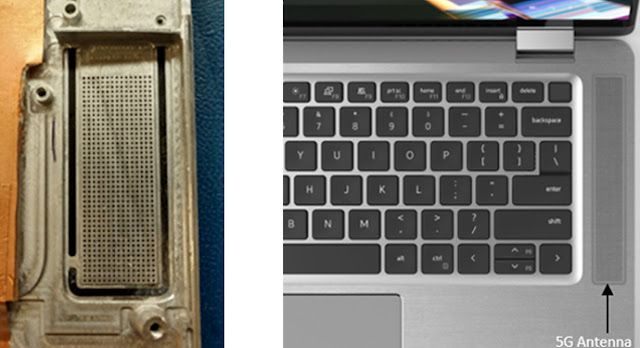
Dell EMC Study Material, Dell EMC Certification, Dell EMC Exam Prep, Dell EMC 5G

5G is about more than the device in your hand: Our early 5G tests show that Dell Latitude 9510 can provide up to 300% improvement in download speeds over 4G. But there’s more to 5G than speed. The reliability and security it offers mobile executives and professionals over Wi-Fi hotspots will transform productivity during travel. 5G will boost capacity and performance for mobile broadband, provide real-time edge compute capacity, and provide purpose-built connectivity for end devices.

The improved wireless capability of 5G networking will bring new use cases and applications, expanding the array of devices, IoT use cases, and services beyond what is possible today. Think automated surveillance of industrial sites, remote maintenance in factories, remote telesurgery, autonomous driving and 3D manufacturing with collaborating industrial robots. It’s more than the 5G device – it’s about the possibilities 5G can enable.

So, while we celebrate this step, we continue our march onward. We look forward to sharing more on our carrier partnerships and unique use cases soon. For pricing and availability on the 5G-capable Latitude 9510 in Europe, enterprise customers may call their customer sales representative.

Saturday, 18 July 2020

To the Edge and Beyond: Network Function Offload

In the first two blogs in this series we discovered what a programmable fabric is and what it looks like. Now we are ready to dive deeper into programmable fabrics and discover Network Function offload.

Telecom communication service providers need to provision Network Functions (NFs) in their infrastructure in order to run the network.  NFs like a BNG (Broadband Network Gateway) for terminating fixed access subscribers or UPF (User Plane Function) for terminating 5G wireless subscribers. These NFs have been evolving from physical boxes to virtual network functions and their disaggregation is key to being able to truly scale and grow the network.

However, the evolution of NFs to date has been fraught with performance and scaling problems as legacy BNG and UPF vendors looked to quickly virtualize their NFs without taking advantage of newer technologies and architectures. Programmable fabrics is one such technology that could potentially help scale NFs by allowing their user plane portions (the most I/O intensive portion) to be “offloaded” into the network.

Dell EMC Study Material, Dell EMC Certifications, Dell EMC Guides, Dell EMC Exam Prep

Figure 1 – Network Function Offload

CUPS (Control User Plane Separation) is the terminology used to describe the separation of the control plane part of a network function (NF-c) and the user plane portion of the network function (NF-u). This separation of control and user planes allows them to be scaled independently and for the user plane to be pushed down into the programmable forwarding engine of the SmartNIC or Switch (see diagram below). This frees up the server CPU cores from doing mundane packet processing and all the performance and tuning problems that this normally brings in a DPDK environment (i.e. Hugepages, NUMA balancing, CPU pinning, etc).

Stand alone mode: where the NF-c will use the standardized DP interfaces (i.e. P4 Runtime, gNMI and gNOI) to communicate directly to the Data Plane nodes. This is useful in the early stages of a programmable fabric implementation where the coming together of the PFE pipelines into a single data plane node is premature and not practical (i.e. the early implementations are more likely to implement separate BNG, UPF and Fabric Management pipelines on separate SmartNICs and switches).

Dell EMC Study Material, Dell EMC Certifications, Dell EMC Guides, Dell EMC Exam Prep

Figure 2 – Network Function Offload

Fabric Controller mode: where the NF-c will use the standardized Fabric Controller interfaces to configure and manage the NF user plane (NF-u) function in the PFE pipeline in the data plane node. While this is probably the optimal future state it will take clearly defined Fabric Controller interfaces and appropriate policy and collaboration from all NF applications.

Dell EMC Study Material, Dell EMC Certifications, Dell EMC Guides, Dell EMC Exam Prep

Figure 3 – NF-c in Fabric Controller mode

NF-u Pipeline

The user plane portion of the network function (i.e. NF-u) is pushed down into the programmable forwarding engine (i.e. SmartNIC or Switch) into what we call the “pipeline.” The pipeline is basically the set of functions that get applied to each and every packet as it comes into the SmartNIC or Switch. We use a network domain specific programming language called P4 to describe this pipeline.

When NFs need to be added to a single P4 pipeline this can then complicate the pipeline and requires some coordination of access to the individual P4 tables as can be seen in the addition of the BNG functional block to the general fabric pipeline depicted below.

Dell EMC Study Material, Dell EMC Certifications, Dell EMC Guides, Dell EMC Exam Prep

Figure 4 – P4 pipeline

The ONF Stratum project is used to provide the Data Plane Agent (DP-Agent) and provides standardized northbound interfaces (P4 Runtime, gNMI & gNOI) for the NF control plane (i.e. BNG-c) and integrates south bound to the Intel PAC N3000 FPGA SmartNIC.

ONF’s Stratum is also integrated into other switches, with both programmable and fixed pipelines and more will be integrated over time. This then allows the hardware integration to Stratum to be done once and then leveraged by many different NF vendors rather than each vendor needing to do a customer integration to a SmartNIC or Switch. 

Network Function offload is a very interesting use case for Telecommunication providers as it will allow them to truly scale their NFs, while freeing up server CPU cores to do other edge use case processing (IoT aggregation, Augmented Reality, Content Delivery, and so forth). Dell Technologies is committed to helping our customers build out the next generation Telco Edge using open standards where possible like our Open Programmable Service Edge architecture.

Saturday, 6 June 2020

Protecting the Telecom Network

Telecommunication networks are becoming more and more essential every day and, in the process, gaining new opportunities. These opportunities will drive new business growth and create exciting areas for revenue generation. However, as with all opportunities, challenges exist. And for communication service providers (CSPs), these challenges include cyber threats, increasing network decentralization, timing requirements, and more.

To help our customers meet these challenges, Dell EMC Ready Solution for VMware NFV brings together industry-leading technologies optimized for telecommunication networks, yet customizable for any unique need. This solution continues to offer new value with the latest release including newly integrated Data Protection capabilities for streamlined and trusted performance.

Fortifying your Data Protection Strategy with Dell EMC Data Protection Solutions


Cyberattacks, can have far-reaching effects resulting in downtime and data loss. Since CSPs are at the center of the modern transformation controlling and operating critical infrastructure, it is even more important to have a robust data protection strategy built around the principles of high availability to ensure service continuity. These trends and the continued evolution of cloud environments are causing CSPs to fortify their data protection strategy.

Dell EMC Study Material, Dell EMC Guides, Dell EMC Certification, Dell EMC Exam Prep

Dell EMC’s data protection suite offers network administrators a simplified approach to control backup, recovery, and replication management with over 2.7 EB (exabytes) of data in the cloud. It is optimized for virtual environments, with a unique, client-side, global deduplication technology that eliminates redundant backup data before it is sent over the network and stored.

Designed for the unique requirements of CSPs, this data protection suite seamlessly integrates with VMware Cloud Director (vCD) through Dell EMC Data Protection Extension (DPE) for vCD. Dell EMC DPE for vCD provides unified end-user NFV infrastructure management. This facilitates tenant self-service access through vCD’s tenant user interface (UI), allowing for tenant-level policy configuration and setup of tenant repositories. Additionally, for those with VMware Integrated Openstack (VIO), we have also validated and documented the integration of VIO with Dell’s Data Protection Suite.

Dell EMC’s data protection suite includes both Avamar (source-based deduplication software) and Data Domain (target deduplication software) integrated through DD Boost (solution for optimized software interaction). These leading components provide fast, reliable, and flexible data protection that scales to the needs of the largest CSPs while allowing for expansion to the public cloud. Additionally, Dell EMC data protection suite provides encryption and file locking for data security, protecting critical infrastructure from cyber threats.

Key features of the data protection suite include:

◉ VMware Cloud Director UI integration
◉ Tenant self-service access
◉ Client-side global deduplication
◉ DD Boost enhanced backup speed
◉ Multi-cloud environment
◉ Encryption and file locking
◉ Non-disruptive policy-based enforcement
◉ CBT and FLR for efficient data restore

Dell EMC Ready Solution for VMware NFV Platform


With Dell’s powerful data protection suite integrated with Dell EMC’s VMware NFV solution, there has not been a better platform to position CSPs for success. Built using NFV best practices for disaggregation and validated for carrier-grade performance, this solution ensures the flexibility and capability to execute on strategies with complete peace of mind.

This integrated solution is built on top of leading Dell EMC hardware and VMware software, providing an exceptional NFV foundation. With a broad offering of components from Dell Technology, customization is made simple for a prescriptive and optimized network. Benefits include:

◉ Enabled agility with peace of mind through validated and disaggregated infrastructure

◉ Operate with performance and efficiency, leveraging ideal tools for assurance, automation, orchestration, and analytics

◉ Stacked to win with a co-engineered solution built on top of leading Dell EMC assets and VMware software for NFV use cases

◉ Investment protection with a carrier-grade solution meeting SLA requirement via features such as Long-life Intel® Xeon® processors in PowerEdge R-Series servers

What’s New?


Dell EMC reference architectures for VMware vCloud NFV are central to delivering the value of this solution. The most recent reference architecture, Dell EMC Ready Architecture for VMware vCloud NFV, includes the latest VMware release with vCloud Director 9.7.  This architecture facilitates a unified deployment from the core to edge with VMware’s vCloud Director plus data protection.

◉ Enhanced data protection using Dell EMC Data Protection Extension, Avamar, and Data Domain
    ◉ DPE Plugin seamlessly integrates Dell’s data protection capabilities with VMware through vCD UI
    ◉ Up to 47% lower monthly cost of in-cloud data protection
    ◉ Up to 1.5x faster backups on Day 1
    ◉ Up to 3x faster incremental backups
◉ Single integrated solution for network Edge and Core
    ◉ Facilitating end-to-end deployment
    ◉ Edge architecture designed for unique requirements
    ◉ Core offload of edge site overhead
◉ Based on vCloud NFV 3.2.1
    ◉ vSphere performance and security improvements
    ◉ Additional NUMA balancing feature
    ◉ Edge-centric features
    ◉ IPv6 support

Our reference architectures facilitate faster deployments, simplified management, and optimized performance. We are excited to be able to provide a single end-to-end solution for VMware Cloud NFV that includes data protection.

Dell Technologies is committed to offering telecommunication-optimized, modular, and open standards-based solutions to deliver infrastructure that is designed for CSP clouds and accelerates 5G monetization.

Tuesday, 31 March 2020

Creating a User Experience Fit for a Mobile Workforce

Dell EMC Study Materials, Dell EMC Learning, Dell EMC Guides, Dell EMC Cert Exam

Because of the international nature of my work, I’m often traveling for four days out of every week, and I might connect from as many as ten different places a day. Between 6 a.m. and 9 p.m., I use internet connections at airports, coffee bars and hotel lobbies, and the amount of time I spend online in each case can vary between five minutes and two hours.

In fact, every employee is a ‘consumer of the workplace,’ no matter where they are in the world, and they can all benefit from an improved experience. Fast connectivity and easy access to email servers and collaboration software from any location are paramount for efficiency.

Remote working is on the rise


As the world becomes more complex, we must leverage simple solutions to meet new challenges. The reality today is that more than two-thirds of people around the world work remotely at least once a week, networked teams are replacing the static workforce and new generations entering the job market expect a mobile work environment. Nearly 70 percent of organizations acknowledge that a mobile workforce enables business strategies.

To guarantee a fluid user experience, the mobile workforce depends on easy-to-use B2B applications and a fast and accessible internet connection. However, the wide range of consumer applications people use in their everyday personal lives usually offer a better user interface than B2B applications designed for ‘consumers of the workplace.’ As a result, the average employee is inefficiently switching between 35 job-critical applications more than 1,100 times every day.

We shouldn’t cut corners when it comes to the user experience. A well-designed user interface can increase the conversion rate by 200 percent for B2C websites, so imagine what an easy-to-use business application could do for the employee experience. So let’s take a look at the possibilities for improving this experience and attracting the next generations to our workplace of the future.

Flexible work enhances collaboration


Whether working remotely with a colleague in another country or facilitating a brainstorm meeting with 50 people at the office, advancements such as 5G, collaboration apps and conference software offer not only a greater number but also more efficient ways of working together, adapted to what customers expect from companies.

As products evolve, companies have to adapt their service offering – internally as well as externally.

Sandvik, a high-tech engineering group that offers tooling and tooling systems for metal cutting, needed to gain a better understanding of its internal users, because people are increasingly working remotely, around the world, both in the offices and from inside mines. Sandvik now takes a completely new approach to digital happiness: offering a customized experience without offering too many options, enabling a sense of empowerment for IT as well as for the end user.

The ability to work from different locations is critical. Flexible work is beneficial for companies, it motivates people to take the next step in their career and it definitely benefits the environment.

Flexibility puts employees more in charge of their commute time, their way of working and their work-life balance. This is exactly what Shiseido, a worldwide cosmetic company, had in mind when it transformed the workplace. Half of the workforce, a total of 2,000 people, are now working remotely. Together with Shiseido we developed a custom-made workplace solution giving the right person and the right device access to the data needed to work securely from any location.

Installing a culture of trust


Investments in technology are not the only prerequisite for facilitating distributed teams or remote working. The remote workforce also has to be supported by HR. People need to be comfortable with this way of working. Top-down decisions enable processes that install a culture of trust in the company.

Promoting collaboration through technology starts at the office. Companies that constantly evaluate what they are offering their employees, while aligning their technology with employees’ needs, are surging ahead in the race for talent. The workplace of the future is tailored to the specific needs of a diverse workforce. There is still plenty of room to learn and improve in terms of interfaces and information-sharing tools.

Technology enhances creative ways of working by making it easier to collaborate with people all over the world, but only if it benefits the user experience. A completely new and broader skills force is available to work on the ever-more complex challenges people face today.

Source: dellemc.com

Thursday, 26 March 2020

Building One of the World’s First MEC Solutions

Dell EMC Tutorial and Materials, Dell EMC Guides, Dell EMC Learning, Dell EMC Certifications

While Multi-Access Edge Computing (MEC) is not dependent on 5G, and 5G is not dependent on MEC, there are clear synergies between the 5G architecture enabling decentralized deployment and MEC enabling new services and experiences. MEC will be a key enabler of future growth for telecoms operators as they roll out 5G services in the next few years.

Although the discussion on edge computing is clouded by hype and at times misinformation, we are starting to see real examples of edge computing being used across industries. Mobile operators globally are building MEC sites – both in their own facilities and on customer premises – launching new services to enterprise customers.  Service providers (SPs) like AT&T, SK Telecom (SKT), SingTel, KDDI, Vodafone and Deutsche Telekom are some of the early providers of edge solutions.

Dell Technologies is working with SK Telecom to help the operator build and deploy its own MEC platform in 2020, accelerating the industry leader’s 5G MEC strategy.

SK Telecom: a 5G and MEC pioneer


SK Telecom is the largest mobile operator in Korea and an industry leader in many respects: it has both a strong core offering with over 41% market share (as of July 2019) and significant revenues outside telecoms, primarily from security and commerce. (USD $7.9Bn revenues in FY 2018).  It was the first to launch 5G in April 2019 and managed to accumulate over 1 Million 5G subscribers 8 months later, 10 times the total number of 5G subscribers in the U.S. across all operators in the same period.  They have achieved the widest 5G coverage in South Korea rolling out its 5G network to data traffic-concentrated areas, including the main areas of 85 cities nationwide.  Their ambition is to continue the growth of 5G services in the B2B and B2B2X sectors, offering low latency solutions to enterprises (e.g. security), industry (e.g. smart factory) and developers (e.g. cloud gaming).

However, 5G alone is not enough. MEC is a critical enabler for delivering low latency services at guaranteed levels, data-centric services (such as IoT), differentiated customer experiences, improved security and reduced TCO to the end-customer.  In traditional networks, round-trip latency to the cloud generally averages between 30 to over 100 milliseconds. With MEC, this could potentially drop to under 10 milliseconds.

SKT is offering two types of MEC: distributed MEC leveraging its own facilities and on-premises MEC, where edge compute infrastructure and services are deployed for a customer on their selected sites. The target applications across these MEC domains include:

◉ Distributed MEC:
     ◉ Cloud VR
     ◉ Virtual mobile interface
     ◉ Traffic management
     ◉ Cloud gaming
◉ On-site MEC:
     ◉ Smart factory (machine vision)
     ◉ Smart hospital
     ◉ Smart robot

With MEC, collaboration is key

SKT has an open approach to developing its MEC offering, emphasising the need to work closely with different partners in the ecosystem:

1. Infrastructure vendors, including Dell Technologies and Intel
2. Software vendors
3. Public cloud providers
4. Global SPs

SKT has already announced its partnership with AWS for Wavelength, its 5G MEC offering that will launch in 2020. The mobile operator views cooperation with public cloud providers as a critical component to seed the market and allow developers to add workloads to MEC or move them from the public cloud.

A recent announcement on SKT’s initiative with the Bridge Alliance demonstrates the need to collaborate within the telecoms industry. The Global MEC Task Force includes other Bridge Alliance members (e.g. Singtel, Globe, Taiwan Mobile and PCCW Global) and seeks to accelerate progress of 5G and MEC across SPs globally. The Bridge Alliance alone encompasses 34 operators serving more than 800 million customers across the Asia Pacific region.

Dell Technologies provides the foundation for the MEC architecture


In addition to working with cloud providers, SKT has built its own MEC architecture to provide a platform with diverse environments for MEC application workloads to run on bare metal, virtual machines and containers. Using the platform, developers can manage and orchestrate workloads on SKT’s MEC infrastructure.

SK Telecom’s MEC architecture

Dell EMC Tutorial and Materials, Dell EMC Guides, Dell EMC Learning, Dell EMC Certifications
Source: SK Telecom

Underpinning this is Dell Technologies’ infrastructure, offering both best-in-class network switches to manage the real-time traffic flows to and from the MEC nodes and edge servers, hosting the MEC workloads. The Dell Technologies infrastructure also offers the management framework to integrate into SKT’s existing Operational Support Systems (OSS) environment, easing the deployment and day-to-day operations of this network at scale.

Thursday, 6 February 2020

5G and Me: And Security

Dell EMC Study Materials, Dell EMC Guides, Dell EMC Learning, Dell EMC Prep

In today’s uber-connected world, everyone has dealt with that little voice in the back of the head, asking if you are safe… Is your data safe? Is your “stuff” private and protected? Are your connections exposing you to security attacks? And rightly so. It is nearly impossible to predict all the ways in which crooked minds (i.e. hackers and thieves) will steal your everything in but a moment, given a chance.

In the world of security, experts think in terms of “attack surfaces.” These are all the ways and methods, simply put, in which the bad guys can launch attacks that can hurt you. They can hurt an individual at a time, or a whole nation. The basic principles of security remain the same: identify all the attack surfaces. Turn off all access to the attack surfaces. Then monitor closely and monitor often for any suspicious activity. Rinse and repeat.

This recipe, however, only works with the attack surfaces you are aware of, aka the “known unknowns.” What about the “unknown unknowns?”

With 5G emerging—the hyper-connectivity, the bandwidth guarantees, the low-latency guarantee, the scale, and the expected ubiquity—there is potential for a huge number of unknown unknowns. For the first five years of 5G deployments, humanity is going to discover attack surfaces that we had never thought of before. If one contrasts 5G design and architecture with 4G, it definitely includes stronger and more robust security principles. However, compared to 4G, the risk profile of a 5G transport may be far worse as 5G is expected to carry more mission-critical services that 4G currently does, and as a scale far greater than 4G ever will.

Here is an example: How about weird atmospheric phenomena that unpredictably open electromagnetic tunnels through layers of Earth’s atmosphere, exposing mobile networks to devices hundreds of miles away? When that happens, how will a physically remote hacker exploit the new large-scale, superfast 5G transport you just deployed? How about a rogue nation that wants to attack your critical IoT infrastructure riding on 5G?  While this problem affects all uses of the electromagnetic spectrum (including 4G), 5G will have a lot more riding on it, including national critical infrastructures. I am sure you would prefer to just close the tunnels if you could, rather than find out the answers to these questions.

Then there are the garden-variety of attack surface types to be expected, yet remain hidden until exploited and discovered. These are:

1. Network fragility: A 5G network will be built on a foundation of virtualization, a technology proven in the data center, but less so in the telecom transport sphere where physical functions are the norm. Virtualization is great for cost and efficiency, but also requires careful and balanced pre-allocation of resources. By targeting resource imbalances in virtualized stacks, could hackers negatively impact 5G service delivery, and cause a cascade of such events? It’s not out of the question.

2. Increased system complexity: The ambitious goals of 5G require the systems that implement to be quite complex. A complex system with more virtualized and sometimes dedicated parts such as accelerators can provide multiple ways to attack. This can adversely impact everything the system carries.

3. Single points of failure: We know that there will be SPoFs. But where? And how do I know it will be the weakest link in the chain?

4. Plain-old physics of it: The ionospheric tunnel is an example of what the physics of the spectrum can do. It may be hard but it’s certainly not impossible to hijack a part of the spectrum when such physical phenomena permit and exploit them with a denial-of-service (DoS) attack, and close up with not so much as a ripple on the pond.

5. Layers of disaggregation: This is a fundamental principle on which 5G is based. While it enables elegant and efficient designs and implementations, it also opens opportunities for bad actors to hide or inject their agents between those layers of disaggregation. How will they use a beautiful design principle as an attack surface? We will only find out as it happens.

6. Multi-actor networks: The disaggregated design opens up the possibility of multiple business entities collaborating to meet the goal of carrying your 5G-based services. The flip side? They will promise service levels to each other, but they must trust each other to be able to operate together. What, how and who might hijack a trust token (for example), and bring all actors down to some nefarious goals? When that happens, who is at fault? Who is on the hook to pay a price?

7. 3rd-party Applications: Many 5G-based services will be implemented via applications provided by 3rd The new openness and innovation that this ecosystem will enable could become a set of attack surfaces for hackers to exploit. It is near-impossible to check and test each and every 3rd party application for loopholes a priori, and may become attack surfaces that will significantly increase 5G security risk.

Security experts are often heard saying that it’s not if you will be attacked, only when. With the emerging 5G world, we confess that we are only beginning to understand the how of it, i.e. the new and emerging unknown unknowns.

At Dell Technologies, we provide infrastructure expertise to build scalable, dependable and secure 5G networks. In future blog entries on this topic, we will continue to provide more insights into how 5G and security are at once both scary and exciting to embrace for the 5G user. Stay tuned!

Saturday, 13 January 2018

Deal Registration from Anywhere, at Any Time with the Dell EMC Partner App


You’ve just had a great customer meeting and there’s a major opportunity coming down the pipeline. You want to register the deal right away, but you still have three more client calls to make before returning to the office. You know that if you don’t lock in the opportunity, you could lose out on potential discounts and a preferred partner status…


Enter the Dell EMC Partner app, which makes it easy for you to register deals on the go, from almost anywhere and at any time.

This intuitive app lets you register a deal, check a deal’s status (won, lost, cancelled) and retrieve supplementary deal status information. With the Dell EMC Partner app, you’ll know immediately the number of days until a deal expires or the stage of active deals (e.g. “qualified 30%”). In addition, the Dell EMC Partner app enables you to be more productive—giving you more time with clients and reducing the amount of time you spend on administrative tasks.

Newly Launched


The just-launched Dell EMC Partner app (which replaces the Dell PartnerDirect App) makes it easier to register deals on the go. The app will initially be available in 14 countries including USA, Canada, Brazil, Mexico, Australia, UK, Germany, France, India, Philippines, Malaysia, Singapore, Korea, and Japan, The release of this app includes an upgraded authentication method. Simply use your Partner Portal login to access the app—and all of your deals.

Some of the features of the Dell EMC Partner app include:

Easy Deal Registration – Register a deal with Dell EMC faster. Simply create a deal, add products and submit—all with just a few clicks.


Check Deal Status – Monitor the status of your deals right from the app; and receive alerts when a deal is about to expire.


Save Draft Deals – The app enables you to create a deal draft and then submit to Dell EMC only when you are ready. Within the app, you can take notes, enter deal info, add products and save as a draft.